I still remember the first time a diary entry question showed up in my English paper. I thought, “This is the easiest question on the page, it is just my own feelings.” I wrote three messy paragraphs, forgot the date, skipped the greeting, and lost marks for something I could have fixed in two minutes. That is the funny thing about the diary entry format: the writing feels free, but the exam still checks whether you followed a pattern.
In this guide I will walk you through the exact diary entry format the way I wish someone had explained it to me: what to write, in what order, how long it should be, and where students quietly lose marks. Whether you are looking for the diary entry format for Class 6, 7, 8, 9 or 10, the structure is the same, so you only need to learn it once.
What Is a Diary Entry?
A diary entry is a personal record of something that happened to you on a particular day, along with how you felt about it. Unlike a formal letter or a report, you are not writing for an audience. You are talking to yourself, which is why the tone is informal, honest and emotional.
In school exams, however, the question is usually built around a situation, such as a school trip, a win, a disappointment or something you saw. You are expected to imagine yourself in that situation and write as if it happened to you.
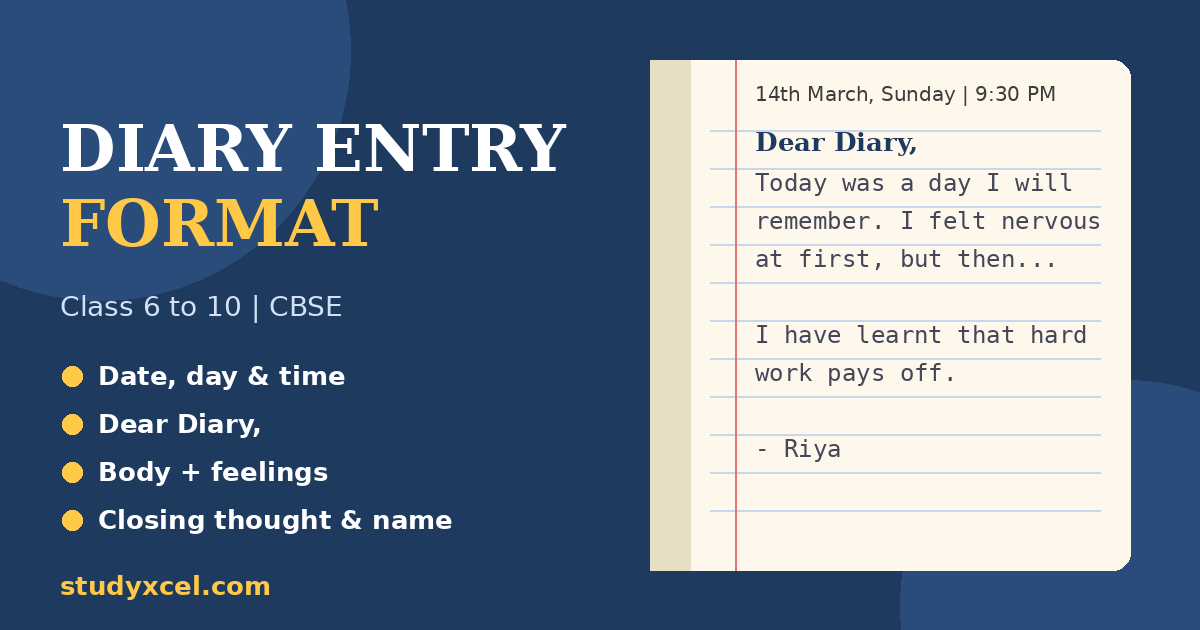
Diary Entry Format in English (Standard CBSE Format)
This is the format I recommend for every class from 6 to 10. It works for CBSE, ICSE and most state boards.
- Date and day: Write it at the top, usually on the left. Example: 14th March 2027, Sunday.
- Time: Mention the time below the date. Example: 9:30 PM. Many students skip this, and it is an easy habit to build because most people write diaries at night.
- Salutation: Begin with “Dear Diary,” on a new line.
- Body of the entry: Write what happened, how you felt, what you learned or decided. Use the first person (I, my, me).
- Closing thought: End with a line about your hope, plan or lesson.
- Signature: Write only your name or initials at the bottom. In the exam, if a name is not given, use the one in the question or write a neutral name as instructed.
Quick template you can copy into your notebook:
14th March 2027, Sunday 9:30 PM
Dear Diary,
[Paragraph 1: what happened, where and with whom]
[Paragraph 2: how you felt and why]
[Closing line: lesson, hope or plan]
Your name
Diary Entry Format for Class 6, 7, 8, 9 and 10: Is It Different?
Short answer: no. Students often worry that the diary entry format for Class 10 is different from the diary entry format for Class 9, but it is not. What changes is the depth of your content and the quality of your expression. A Class 6 entry can be simple and short. A Class 9 or 10 entry should show a clearer sequence of events, stronger vocabulary and a reflection at the end.
Diary Entry Marking Scheme and Word Limit (CBSE)
This part is where students need to be careful, because different websites show different numbers.
- The official 2026-27 Class 9 English (Language and Literature) syllabus lists “Writing a Story (on a given cue/title)/Diary Entry” in 100-120 words, with one out of two questions to be attempted, carrying 5 marks.
- Several study sites also show the same 100-120 word pattern for Class 10 writing skills, where Story Writing/Diary Entry is a 5-mark question.
- Older articles mention a 4-mark question and a 100-150 word range. These belonged to earlier patterns.
My honest advice: always open the latest syllabus on the official CBSE Academic website and confirm the marks and word limit for your class and session before you start practising. Syllabus details can change, and your school may also follow its own pattern for unit tests.
The assessment usually looks at two things: content (is your entry relevant, complete and in sequence?) and expression (is your language accurate, with correct grammar, spelling and tone?). The format itself is checked too, so do not give away free marks.
How to Start a Diary Entry
The best starts are simple. After the date, time and “Dear Diary,” you can open with:
- A feeling: “I am still smiling as I write this.”
- An event: “Today was the day our school finally won the inter-school quiz.”
- A thought: “I never thought a rainy Monday could turn out this well.”
Pick one and move straight into what happened. Do not waste your first line on something like “Today I will write about my day.”
How to End a Diary Entry
A good ending closes the loop. Try one of these:
- A promise: “From tomorrow, I will practise for half an hour every evening.”
- A lesson: “I have learnt that being prepared makes all the difference.”
- A hope: “I hope this feeling lasts till the results.”
Then add your name, and stop. No “Thank you” or “Yours sincerely” is needed, because that belongs to letters.
Solved Diary Entry Examples
Example 1: A School Picnic (Class 6-8 level)
Question: You are going on a school picnic tomorrow. Write a diary entry expressing your excitement.
10th January 2027, Saturday 8:45 PM
Dear Diary,
I can hardly sit still as I write this. Tomorrow our class is going to the botanical garden, and I have been counting the hours since morning. Mummy has packed my bag with sandwiches, juice and a small football, and I have kept my water bottle next to my shoes so that I do not forget it.
What excites me most is that our English teacher, Ms Sharma, will also join us, and we plan to play antakshari on the bus. I have promised my best friend Aman that we will sit together and share our snacks.
I must sleep early now, or I will be too tired to enjoy tomorrow. I only hope the weather stays pleasant.
Riya
Example 2: Winning a Competition (Class 9-10 level)
Question: You won the first prize in your school’s inter-house debate competition. Write a diary entry about your feelings.
22nd February 2027, Monday 10:00 PM
Dear Diary,
Today was one of those days I will remember for a long time. When the judges announced my name as the winner of the inter-house debate, I felt my heart skip a beat. For a moment I thought I had misheard.
The last two weeks were not easy. I rewrote my speech four times, practised in front of the mirror and even asked my father to play the opposition. When my turn came, my hands were shaking, but the moment I started speaking, the nervousness disappeared.
What I value most is not the trophy but the feeling that hard work does pay off. I also learnt that fear fades when you are well prepared. Tomorrow I will thank my teacher for believing in me.
Kabir
Both examples are written in the first person, stay within the 100-120 word range for the exam version if you trim a little, and follow the date, time, salutation, body, closing and name pattern.
Diary Entry vs Letter: Do Not Mix Them Up
| Point | Diary entry | Letter |
|---|---|---|
| Reader | Yourself | Another person |
| Greeting | Dear Diary | Dear Sir/Madam or Dear Friend |
| Tone | Personal, emotional | Formal or informal, depending on the type |
| Sender’s address | Not needed | Needed (in formal and informal letters) |
| Closing | Your name | Yours sincerely, Yours faithfully, etc. |
8 Common Mistakes That Cost Marks
- Forgetting the date or day.
- Writing “Dear Diary” in the middle of the page instead of the start.
- Writing in the third person (“He felt happy”) instead of the first person.
- Using very formal words, which breaks the personal tone.
- Writing only events with no feelings.
- Going well beyond the word limit.
- Ending with “Thank you” or “Yours sincerely.”
- Messy handwriting and spelling mistakes in easy words.
Diary Entry Topics for Practice
Here are some situations I would practise with:
- Your first day in a new school
- A trip to a hill station or heritage site
- A day when you helped someone in need
- Winning or losing a sports match
- Your experience of a school fest or annual day
- A rainy day spent at home
- A time you felt nervous before an exam or result
- Your experience during a cleanliness or tree-plantation drive
Tips I Wish I Had Known Earlier
- Practise with a timer. A 100-120 word entry should take 7 to 8 minutes in the exam, including a quick check.
- Plan three lines before you write: what happened, how I felt, what next.
- Use feelings words such as thrilled, anxious, relieved, proud, disappointed, grateful.
- Keep paragraphs short. Two short paragraphs and one closing line are enough.
- Read your entry aloud once. If it sounds like you talking to a friend, you are on the right track.
- Do not copy sample entries. Examiners notice memorised answers. Write your own detail.
Free Resources to Practise Diary Entry Writing
Use only trusted sources while preparing:
- CBSE Academic website for the official syllabus, sample papers and marking guidelines.
- NCERT for textbooks and e-books. Reading the diary-style chapter “From the Diary of Anne Frank” in Class 10 First Flight shows how real diary writing sounds.
- Anne Frank House for background on Anne Frank’s diary, a real example of reflective diary writing.
- DIKSHA for free learning content from the Government of India.
- Embibe: Diary Entry Format for another set of examples and a Q&A section.
More from StudyXcel:
- Explore more study guides on the StudyXcel homepage.
- Related posts you can link here: your UGC NET Paper 1 preparation strategy guide, and other writing-skills posts such as notice writing, letter writing and article writing, once they are live on the site.
Frequently Asked Questions
1. What is the correct diary entry format? Date and day, time, “Dear Diary,” the body in the first person, a closing thought, and your name.
2. Is the diary entry format the same for Class 9 and Class 10? Yes. Only the quality of content and language expected from you changes.
3. How many words should a diary entry be? The current CBSE pattern for Class 9 mentions 100-120 words. Please verify your class on the official CBSE syllabus, because patterns are revised.
4. How do I start a diary entry? Write the date, day and time, then “Dear Diary,” and open with a feeling, an event or a thought.
5. How do I end a diary entry? Close with a lesson, hope or plan, followed by your name.
6. Is it necessary to write the time in a diary entry? It is not always mandatory, but it is a good habit that makes your format complete. Follow what your teacher or school prescribes.
7. Is a box format required? Some schools prefer it, but it is not a requirement for the CBSE writing task. Check with your teacher.
8. Can I use a real name in my diary entry? Use the name given in the question. If none is given, use your own initials or the name your teacher recommends, and avoid revealing identity details in exams.
Final Thoughts
The diary entry is one of the few writing tasks where you can score well without memorising anything, because the pattern is short and the content comes from your imagination. Learn the format once, practise three or four entries with a timer, and you will rarely lose marks on this question again.
If this guide helped, bookmark it, share it with a friend who is preparing for English, and explore more exam-writing guides on StudyXcel.